How to Practice Vocabulary Effectively: The Science-Backed Method
Master your vocabulary with effective practice strategies.
Posted by
 Mike
Mike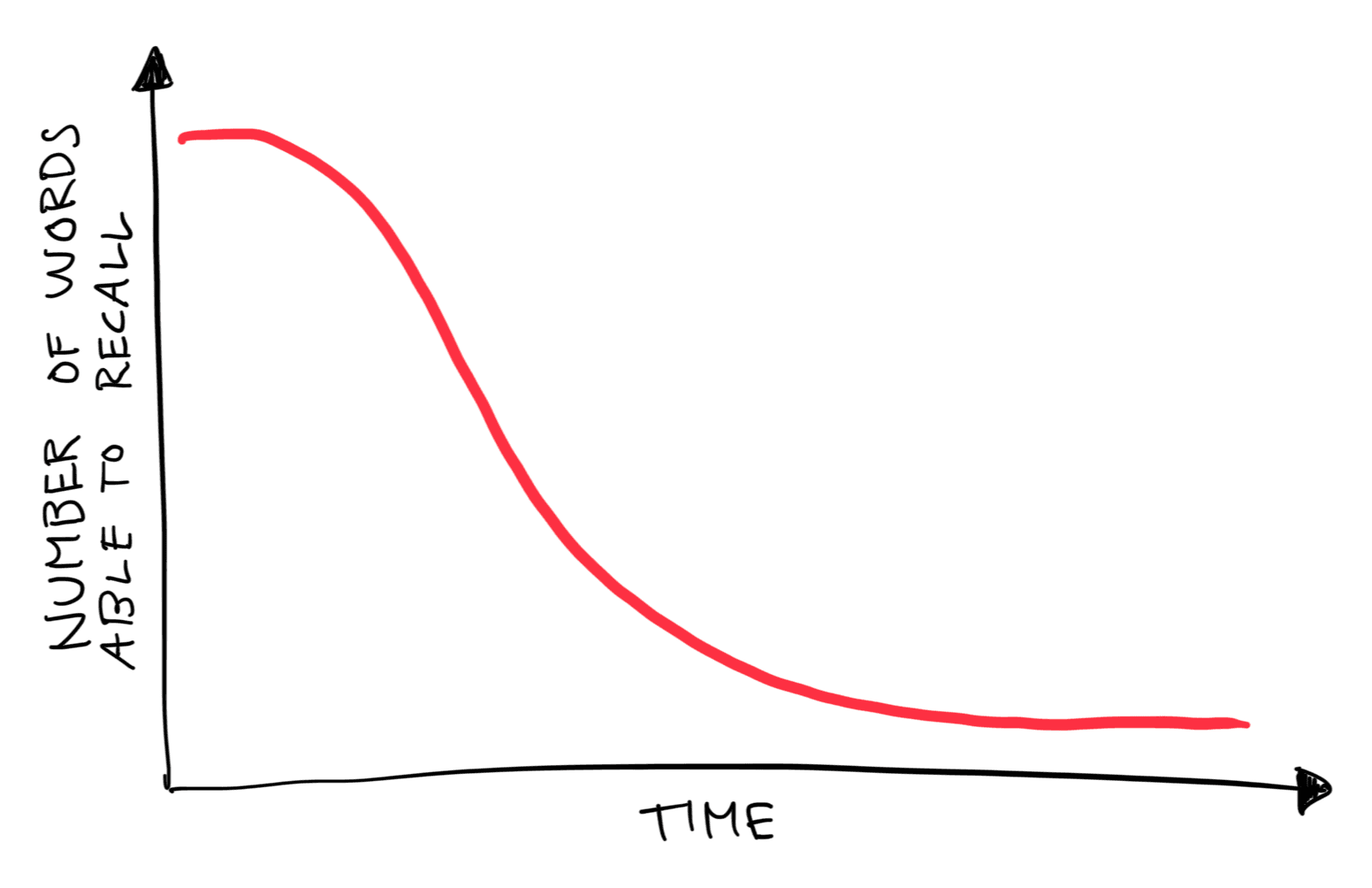 Figure 1: The Forgetting Curve
You probably have been practicing with an app or taking a language class in the past. Despite the long hours of reviewing the words in the chapters, you do not remember them when you need to. The most frustrating truth about learning is that you forget half of it within days.
The problem is not you. It is how you are practicing.
The only cure is consistently study with time in between, also known as spaced repetition. You need to give your brain time to consolidate the new learning. The ultimate way is at each session to test yourself, that is trying to recall them, not only read them again.
In this post, we review the literature on why and tell you how to use that to your advantage.
A brief literature review
Scientists have studied how people remember things for over 100 years. Here is what they found.
You forget things quickly. Hermann Ebbinghaus showed that people forget about half of what they learn after a few days (Ebbinghaus, 1885). He first depicted the effect in a curve call the Forgetting Curve (see Figure 1).
If you do not review what you learned, you will forget most of it over time. You might realize that you can recall something easily that you just learned. That is your short-term memory playing tricks on you. You have only really learned when you are able to recall the information from your long-term memory.
Spacing out your practice helps you remember longer. Bahrick & Phelps (1987) taught adults on 50 Spanish language word pairs and then tested them 8 years later. One group learned and reviewed the words just seconds apart. The other group learned the words and came back for another review session of the same words after 30 days. Both groups practiced the same number of times. They found out that after seven session 30-days apart the retention was nearly perfect. For the group that tried to cram those session on the same day, did not recall many of the words after 8 years.
Another study looked at 254 different studies on learning with over 14,000 participants (Cepeda et al., 2006). They confirmed that spacing out your practice works much better than cramming.
Testing yourself works better than only reading. A highly cited study compared reading over and over to recall learning (Karpicke & Roediger, 2008). The students studied using different methods: some repeatedly read the pairs of words. Others repeatedly tested themselves before revealing the answer. After one week, the students who tested themselves remembered 80% of the words. The ones who only read remembered only 33% of the words. Both groups spent the same amount of time learning.
A 2013 scientific literature review compared various learning techniques (Dunlosky et al., 2013). They rated self-quizzing and spaced repetition as the two most effective learning methods. The combination of these two methods is the ultimate way to learn anything.
How to study effectively
1. Active recall
Before you flip that flashcard, actually try to remember.
Look at the word, pause, and attempt to recall the translation.
Be honest when marking your answers. Only mark it "known" if you actually said it in your mind. Do not just reveal the answers and only then decide if you "remembered" it or not. You are cheating yourself. This is where motivation plays a role. Are you here to actually learn or get through some course?
2. Spaced repetition
Your brain needs time between sessions to strengthen memories. But how long?
You know that the interval is good if you remember it but with some struggle.
3. Short quality recall session a day
Quality beats quantity every time.
Five to ten minutes of daily practice will get you further than one hour once a week.
Start with just 10 words per session.
After a while, increase to 20 words and more. Start slowly and build a habit.
Practice at the same time daily. The best time is in the morning when you are fresh after a good night sleep. When practice becomes automatic, you are on the right track.
4. Focus on the difficult words
It is tempting to skip the difficult words because that is uncomfortable.
These words are exactly the ones you need to practice most.
The algorithm shows difficult words more often to try your memory. Trying to recall a difficult word is still learning when you reveal it after a wrong answer. You need to commit to the practice.
If a difficult word does not seem to stick to your brain, you need more examples of real world usage. Go find that and then try again.
What to avoid
-
Cramming: Trying to learn too many words in a sitting. Your brain needs time to process.
-
Avoiding difficult words: The uncomfortable feeling of not remembering is part of learning. Do not skip that.
-
Being dishonest to yourself: Marking "known" when you know you did not get it right before reveal.
-
Inconsistent practice: Irregular practice breaks the spaced repetition benefit.
Conclusion
Effective vocabulary practice is not about spending hours reading words in one sitting before the exam. It is about staying consistent and using active recall.
Be honest with yourself.
Do not wait till tomorrow to start studying. Make it a habit.
References
Bahrick, H. P., & Phelps, E. (1987). Retention of Spanish vocabulary over 8 years. Journal of Experimental Psychology: Learning, Memory, and Cognition, 13(2), 344-349. https://doi.org/10.1037/0278-7393.13.2.344
Cepeda, N. J., Pashler, H., Vul, E., Wixted, J. T., & Rohrer, D. (2006). Distributed practice in verbal recall tasks: A review and quantitative synthesis. Psychological Bulletin, 132(3), 354-380. https://doi.org/10.1037/0033-2909.132.3.354
Dunlosky, J., Rawson, K. A., Marsh, E. J., Nathan, M. J., & Willingham, D. T. (2013). Improving students' learning with effective learning techniques: Promising directions from cognitive and educational psychology. Psychological Science in the Public Interest, 14(1), 4-58. https://doi.org/10.1177/1529100612453266
Ebbinghaus, H. (1885). Memory: A contribution to experimental psychology. Teachers College, Columbia University.
Karpicke, J. D., & Roediger, H. L. (2008). The critical importance of retrieval for learning. Science, 319(5865), 966-968. https://doi.org/10.1126/science.1152408